Battle of Bulges 21 09 2025
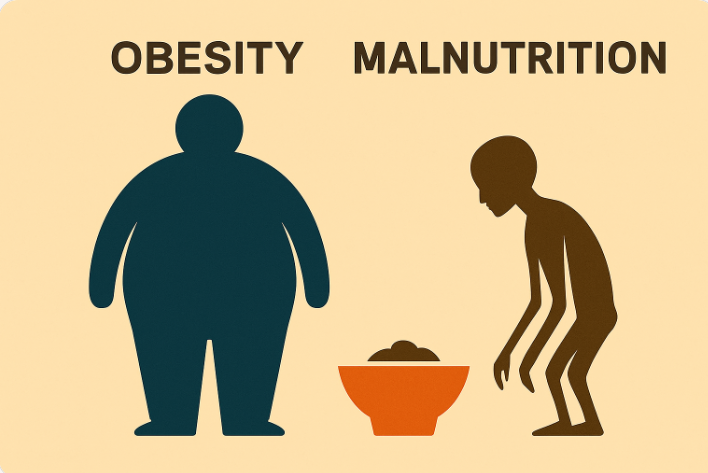
Looks like the struggle to control waistline is not a unique challenge anymore. Along with wealth, waistlines too are growing, and inequality of wealth is literally visible in its twin counterpart, the rapidly growing obesity challenge. In the last decade, global population of obese individuals outstripped the mal-nutritioned, raising serious questions about human sensitivities and sensibilities where one section is challenged to limit their food intake, even as the other section struggles to find enough food to survive.
The World Obesity Atlas 2025 projects there will be 1.13 billion obese people by 2030, a growth of 115% from 2010. In contrast, the number of 673 billion mouths facing hunger have only marginally declined globally, even as its number grows in poorer parts. If diabetes and heart disease are the bane of the obese, stunting, wasting, and anemia are the faces of the malnourished. Sedentary lifestyles and fast food contribute to one, as abject poverty and life in conflict zones account for the other.
There is adequate mind share, and growing resources allocated to managing obesity, whereas the more pressing but easier challenge to solve requiring only resource allocation to eliminate malnutrition remains unaddressed. I often wonder what is wasting and stunting, and how can it be eliminated?
Wasting is the most visible and acute form of nutritional deprivation placing human life in danger. The body rapidly loses weight, NOT due to choice but despite it, due to insufficient caloric intake. Seen mainly in children and the aged and in areas of humanitarian crises like war zones, relief camps and slums, it severely reduces their chance of survival. Therapeutic feeding programs and emergency food aid are the much-needed answers.
Stunting is the challenge of having enough calories to survive, but not enough to grow especially in children. Measured against the norm of desired height to age ratio, it chokes the latent human potential and destroys options available to them to participate in life.
India or for that matter, our global progress should be measured in not just how fast our economies grow and how many billionaires we create, but in the speed with which we eliminate wasting and stunting as the first step in reducing inequality. AI, my new messiah for knowledge, estimates it will take only $7-10 billion annually to eliminate both. In the current era of travel for recreation, especially space travel, is this amount too much to ask?



Social Profiles