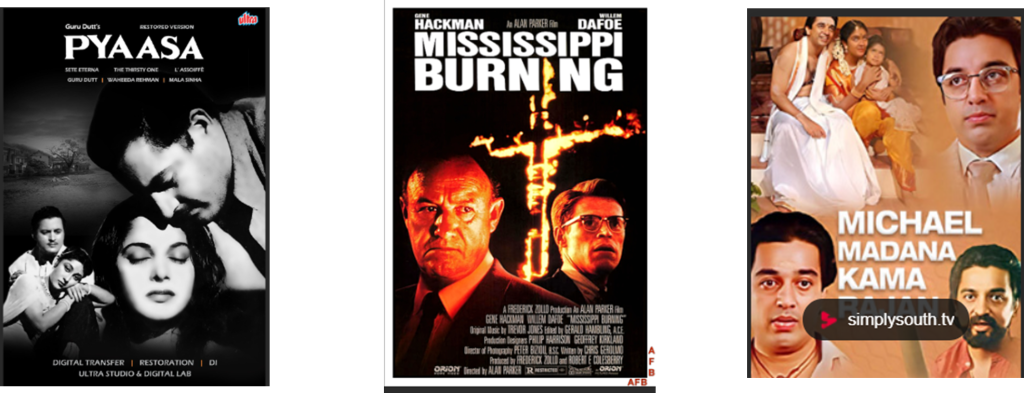
Among the many definitions of art, the one that appeals to me is “art as a means of translating knowledge into experience.” Reflecting on this definition, I often wonder if cinema is the ultimate art form for its ability to create almost ‘real-life’ experiences. I am aware that this is a contentious idea given the longevity and significance of the other art forms like painting, poetry, literature, sculpture, architecture, music, dance and drama. This short write up is my attempt to gain clarity and validate my conclusion.
Placing Cinema in the Art Spectrum
Based on my brief exploration, art can be viewed through any one of the four lenses: considering utility art is bifurcated into fine arts and applied arts, based on senses engaged it is classified into visual arts, literary arts and performing arts, considering time as a scale it is divided into static arts and dynamic arts, and evaluating using dimensions as a criteria into 1-D, 2-D, 3-D, 4-D and 5-D arts.
Classifying art forms into one of these four categories is quite contentious, as examples can be drawn to show how it can fit under more than one category. Given this ambiguity, the guiding principle I have used is to place it where we see majority of the art form fits in and ignore the exceptions.
The classification of art into fine arts, i.e. art used for illustrating aesthetics or providing entertainment in contrast to applied arts that has a more practical utility to human existence is an illustration of how porous this classification can be. For every art that is predominantly a fine art, there are significant examples where it has enriched our human history and shaped how humans have evolved.
The role of poetry in social movements and freedom struggles in unifying and strengthening collective resolve to bring change, painted traffic signs that regulate traffic flows or emojis that we use in digital communications, literature that is used in schools and colleges for education, sculptures used to build models prior to construction or manufacture are some illustrations of fine arts being used as applied arts. On the other hand, architecture which is predominantly an applied art is used in places of worship to evoke the sense of awe and wonder to give us a glimpse of the divine blurring this rigid classification. Similarly, poetry can be both a literary and a performing art, or artists have innovated to show 3-D effects of depth in their paintings blurring the distinction between 2D and 3D categories.
Subject to these qualifications, Table-1, analyses the art forms into the four categories. In addition, a column is added to classify the art form into abstract or concrete. I have classified an art in the abstract category only where there is nothing to visualise or nothing to touch and feel and hence primarily the user’s imagination is engaged by this art.
Table-1: Art forms Analysed
| Sr no. | Art Form | Utility | Senses Engaged | Time | Dimensions | Concrete/ Abstract |
| 1 | Painting | Fine Arts | Visual Art | Static | 2-D | Concrete |
| 2 | Poetry | Fine Arts | Literary Art | Dynamic | 1-D | Abstract |
| 3 | Literature | Fine Arts | Literary Art | Dynamic | 1-D | Concrete |
| 4 | Sculpture | Fine Arts | Visual Art | Static | 3-D | Concrete |
| 5 | Architecture | Applied Arts | Visual Art | Static | 3-D | Concrete |
| 6 | Music | Fine Arts | Performing Art | Dynamic | 1-D | Abstract |
| 7 | Dance | Fine Arts | Performing Art | Dynamic | 4-D | Concrete |
| 8 | Drama | Fine Arts | Performing Art | Dynamic | 4-D | Concrete |
| 9 | Cinema | Fine Arts | Performing Art | Dynamic | 4-D | Concrete |
Note 1: 1-D =Lines or sequence, 2-D= length and breadth, 3-D= length, breadth and depth, 4-D= time added to 3-D, 5-D= extends beyond time and space and brings in interactive elements.
Note 2: Not covered in the table above, best example of 5-D is video games that is cinema like plus interactive.
Cinema as the Culmination of Art Forms
Today the world of cinema is all encompassing for it has evolved at the later stages of art evolution. This enables cinema to fuse all other elements of art into it to make it rich and engaging, requiring the least effort from its audience to appreciate and experience it. The fusion in cinema is where literary and visual arts are converted into a performing art seamlessly is an example. Some of the greatest novels have been converted into classic movies reaching a much wider audience that was outside the scope of literature. For instance, Benhur and Pride & Prejudice in English, The Guide and Devadas in Hindi, Naagarahavu and Baadada Hoo in Kannada, and Asuran and Pooniyin Selvan in Tamil reached audience that are multiple times of the audience reached by literature.
Cinema logically can be seen as the culmination of art form as it subsumes all other art forms into it. At the core of cinema is literature that provides the storyline and becomes its skeleton. Refined drama is the flesh that transforms the storyline and provides its visual appeal. Embedded in the drama are songs that combine poetry, music and dance to make poetry memorable and reach a wider audience. Architecture, sculptures and paintings enrich the visual appeal making cinema addictive.
Despite cinema being at the apex of art forms, I often wonder why the creators of cinema do not have the same prestige and respect that is accorded to other artists like poets, writers, painters, musicians and classic dancers. Is it because they are too much in the limelight? Will the situation change when we realise that cinema is the culmination of all art forms? Only time will tell.
Do you agree with my view that cinema is the ultimate art form? If not can you state why?



Social Profiles