Personal Exploration: From the year 2023, I have written book reviews that summarise my learnings from the books I have read. In 2026, I decided to write down my understanding on certain key concepts for self-reflection and refinement of my learnings. I am sharing this with interested readers for you to critique my understanding and help me refine my learnings. Thank you for your time and support.
Personal Exploration -1 Understanding Values, January 15, 2026
‘We are the sum of what we believe in.’
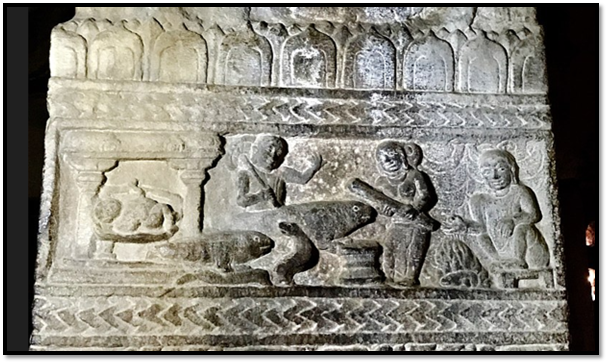
‘Pet Mongoose and the Child’ is a famous Indian folklore that is found engraved in historic Hindu temples like the 8th‑century pillar at the Virupaksha temple in Pattadakal, Karnataka, shown here. In this fable a farmer’s wife leaves her infant toddler along with their pet mongoose as she goes out on an errand. On return, she finds the mongoose with blood dripping from its mouth. Presuming that it has attacked her baby, she kills it, only to later find that the mongoose had killed a snake to protect the child, as she saw the mauled, dead snake lying near the child.
Behaviour is the visible, external manifestation of human thought, while human thought in itself is invisible and can only be inferred. To appreciate and understand behaviour, and where required, to alter, change, modify or erase it, understanding the underlying thought is essential. Thoughts are of two kinds:
- Factual – thoughts that emerge in us which we can see and accept as unchangeable. In the above fable, the mongoose with blood dripping from its mouth is a fact that does not change with person or time, and
- Opinions – thoughts that are preferences or desire that can vary and often lead to action. In the above fable, the thought that the mongoose has killed the baby is an opinion as it depends on the person, past experiences and the situation. This opinion changes when the mother sees the mauled, dead snake lying near her unharmed child to realise the mongoose had actually protected her child by killing the snake.
Opinions are momentary thoughts, but when they persist it can become a belief. In the above fable, an interesting question to ask is why the author has used a mongoose as the pet in the fable and not a more common pet like a dog. In all likelihood, the doubt that a pet dog can kill her child would not be the mother’s opinion and hence would not become her belief leading to the drastic action. But a mongoose, a wild animal as an unlikely pet[1], most probably provoked in her the latent belief that wild animals can attack humans, especially an unprotected infant leading to her swift conclusion and prompt action, without verifying the state of her infant.
As we see in the fable, beliefs are not facts, but what we consider as true based on faith, even in the absence of evidence. The presumed guilt of the mongoose is a belief that led to the action. When beliefs are validated by repeated experiences they become knowledge, and if proven wrong, it becomes a doubtful belief seeking more validation. Beliefs are of three types:
- Descriptive: these beliefs can be labelled as true or false. They are statements about reality and can be validated as true or false by observation or testing or by seeking confirmation. Like for example -Sun rises in the east, humans need air to survive, mobile phones need batteries, New Delhi is capital of India, or moon is a planet, USA is the most populous country, cars don’t pollute are examples of descriptive beliefs that can be either true or false as validated by experience. Experiences can also be manufactured. When an experience is consciously manufactured it is called an experiment.
In the above fable, the farmer had a mongoose as a pet, and they had an infant child, are descriptive beliefs that can be classified as true or false.
- Evaluative: these beliefs can be classified as good or bad based on experience. They result in forming opinions for or against a belief. Examples, honesty is the best policy, hard work pays, teamwork is better than selfishness, education is key to success, or only winning matters, only the weak follow rules, eating fast food is healthy, or wasting food reflects affluence are some examples. The basis for classifying beliefs as good or bad is personally experiencing the consequences of acting on that belief, or in the absence of personal experience, the socially prevailing view about the belief.
In the fable, the belief of retaliation to a violent conduct, and jumping to conclusions can be classified as good or bad beliefs.
- Prescriptive: these beliefs can be judged as desirable or undesirable from the point of utility or practical value as useful /beneficial, or useless /harmful. They promote or inhibit action based on the judgment arrived at by considering the utility. The basis for this judgment is the benefits or harm suffered that follows the action.
From the fable, we can see that acting on unsubstantiated conclusions is a prescriptive belief that can be evaluated using the criteria of benefit or harm it has caused.
While descriptive beliefs can be neutral or factual and are ‘about what is’, evaluative and prescriptive beliefs are in the nature of values, i.e. ‘about what ought to be’, and hence promote feelings or action. The values an individual believes in forms their personal beliefs or ethics, and the collective values of a group are reflected as their norms or morals of that group. Understanding beliefs and norms, that can be grouped under values, are the key to understanding individual behaviour and the collective actions of a group or society.
Values are preferences that stem from our beliefs and can help us predict what will be our likely action in a given situation. Values are reflected in one or more of three visible facets in human life of cognitive, affective and behavioural elements:
- Cognitive -it is the facet of a value being translated into a judgement resulting in deciding if the belief is true or false, good or bad, desirable or undesirable.
- Affective -it is the facet of values triggering an emotional reaction that results in feeling for or against a given situation.
- Behavioural -it is the culmination of a judgment and/or a feeling that results in an action -of promoting or inhibiting the desired state for its resultant utility or benefit.
The basic elements of thoughts translating to beliefs, and beliefs to emotions or action has and will prevail in humans, as it is human nature. We see its workings today in a wide range of spheres with varying implications. For instance,
- Think of a well-behaved child. What do you attribute it to? Role models, education, family upbringing, discipline or innate nature?
- Think of a genius. What are the primary reasons you attribute to their ability? genetics, chance or luck?
- The reason an individual or a team is continuously successful? Talent, culture, resources or manipulation?
- Think of a successful business. What do you attribute its success to? Vision and execution, government patronage, capital and resources at their command?
- Think of a very efficient business executive? What do you attribute their success to? Empathy, goal orientation, developmental focus, or extensive use of monetary incentives?
- Why do customers buy? Attractive price, superior quality, or lack of alternatives?
- Think of a mob lynching. What is the mental image you visualize? Who is the victim and who are the perpetrators? Is it defined by race, religion or crime?
What you decide or visualize without any further details tells you your beliefs.
We can go on listing many more situations where our beliefs reflect our values triggering action. Often this connection or links between ‘thought to belief to action’ is missed, and we are likely to conclude that all human behaviour, both desirable and undesirable as fixed, unchanging aspects of human nature. This is especially evident in judgment about human nature involving questions like:
- Are human beings inherently competitive or cooperative,
- Do the weak and infirm in our society need help and support from the rest,
- Can all humans in this world coexist together peacefully and prosperously,
- Does nature or nurture influence a growing child.
Education, not just formal education for the young, but both formal and informal life-long education through schools, colleges, public media, social media and art in its multifarious forms of music, painting, drama, dance, drama and cinema contribute to the prevailing thoughts in our society thereby shaping our beliefs and the resultant spontaneous action.
This awareness of ‘thought to belief to action’ is the need to study underlying values to shape how we as individuals and groups behave. The desire to promote or deter any type of action needs work at the level of prevailing thoughts and beliefs, irrespective of whether the change is required at the level of an individual, a family, a business, a social, political or religious group.
x-x-x-x-x-x-x-x-x
[1] In my brief search, I was not able to find any more fables or stories in India where mongoose was kept as a pet, except Jataka tales that use mongoose as symbols of vigilance. There are also references to mongoose as a semi-domesticated animal used to protect household from cobras. Given that mongoose feeds on rodents, it is unlikely to have been a common household pet at any point of time.


Social Profiles